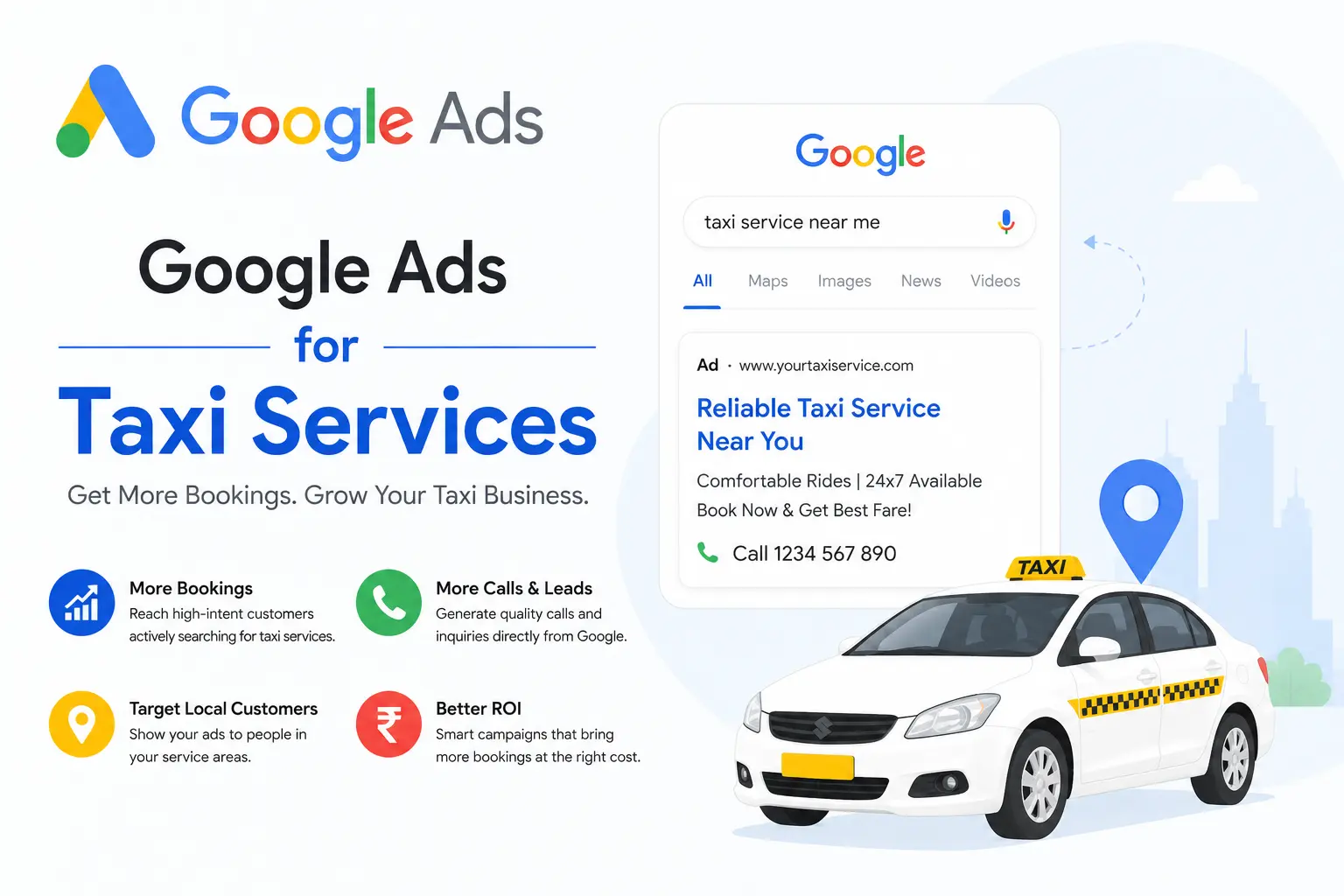
Google Ads for Taxi Services: Complete Guide to Generate More Taxi Bookings
Introduction
The taxi industry has become increasingly competitive as more transportation companies move online to attract customers. Whether you operate airport transfers, local taxi services, outstation cab bookings, corporate transportation, or luxury chauffeur services, reaching potential customers at the right time is essential for business growth.
This is where Google Ads for Taxi Services becomes one of the most powerful marketing tools available. Unlike traditional advertising methods that target broad audiences, Google Ads allows taxi businesses to appear in front of people actively searching for transportation services. These users already have travel requirements and are often ready to make a booking.
When someone searches for airport transportation, outstation taxi booking, local cab services, or long-distance travel options, a properly optimized campaign can place your business at the top of search results. This immediate visibility creates opportunities to generate phone calls, website visits, WhatsApp inquiries, and direct bookings.
Many taxi operators struggle to attract consistent customers because they rely solely on referrals or seasonal demand. However, Google Ads for Taxi Services provides a scalable way to generate leads throughout the year. With the right campaign structure, targeting strategy, and ad copy, taxi businesses can connect with travelers exactly when transportation services are needed.
This guide explains how Google Ads for Taxi Services works, why it is effective, and how taxi companies can use it to increase visibility, generate high-quality leads, and grow their booking volume.
Understanding Google Ads for Taxi Services
Google Ads for Taxi Services is a digital advertising strategy that allows taxi companies to display advertisements on Google Search, Google Maps, and other Google platforms. Instead of waiting for customers to discover your business organically, paid advertising puts your services directly in front of people actively searching for transportation.
The biggest advantage of Google Ads for Taxi Services is intent. Unlike social media users who may not currently need transportation, Google users are searching because they have an immediate requirement. They may need:
- 👉 Airport transfer bookings
- 👉 Local taxi service requirements
- 👉 Corporate transportation needs
- 👉 Outstation cab travel plans
This high purchase intent makes Google Ads one of the most effective lead-generation channels for taxi businesses.
Why Taxi Companies Need Google Ads
The transportation industry is highly competitive. New taxi operators enter the market every year, making it difficult to stand out through traditional marketing alone.
Google Ads for Taxi Services helps businesses appear above competitors when customers search for transportation-related keywords. Instead of depending solely on organic traffic, companies can secure premium positions on search engine result pages. Several factors make Google Ads for Taxi Services valuable:
- Immediate Visibility SEO can take months to produce results. Google Ads can place your business in front of potential customers almost immediately.
- Targeted Traffic Advertisements are shown only to users searching for relevant transportation services.
- Measurable Performance Every click, call, inquiry, and booking can be tracked and measured.
- Flexible Budgets Businesses can start with small advertising budgets and scale campaigns based on performance.
- Local Market Dominance Taxi operators can target specific cities, regions, airports, and service areas.
Benefits of Google Ads for Taxi Services
A well-managed Google Ads for Taxi Services campaign provides advantages that extend beyond generating website traffic.
More Booking Inquiries
The primary goal of Google Ads for Taxi Services is attracting customers who need transportation immediately. These users are more likely to call, submit inquiries, or book rides.
Better Lead Quality
Because advertisements target specific search terms, the leads generated through Google Ads for Taxi Services often have stronger purchase intent compared to other advertising channels.
Increased Brand Visibility
Even when users do not click on advertisements, seeing your company repeatedly can strengthen brand recognition and trust.
Competitive Advantage
Businesses using Google Ads for Taxi Services can appear above competitors who rely only on organic search rankings.
Faster Business Growth
By consistently generating inquiries, advertising campaigns can help taxi businesses expand more quickly.
How Google Ads Works for Taxi Businesses
To understand Google Ads for Taxi Services, it is important to understand how the advertising system operates.
Google Ads functions through a bidding model. Advertisers select keywords they want to target and bid on those searches. When users enter relevant search queries, Google evaluates multiple factors before deciding which advertisements to display. These factors include:
Keyword relevance
Advertisement quality
Landing page experience
Bid amount
Expected click-through rate
A strong Google Ads for Taxi Services campaign focuses not only on bidding but also on improving ad quality and user experience.
Businesses with highly relevant advertisements often achieve better results while spending less per click.
Understanding Customer Search Intent
Successful Google Ads for Taxi Services campaigns are built around customer intent. Different users search with different goals.
Booking Intent
- Airport Taxi Booking
- Taxi Near Me
- Outstation Taxi Service
- Cab Booking Online
These searches indicate immediate transportation needs.
Route Intent
- Delhi to Haridwar Taxi
- Delhi to Rishikesh Taxi
- Chandigarh to Manali Taxi
These searches often produce highly qualified leads because the traveler already knows the route.
Service Intent
- Corporate Taxi Service
- Luxury Cab Service
- Airport Transfer Service
Users know what type of transportation they need.
Information Intent
- Taxi Fare: Delhi to Haridwar
- Airport Taxi Charges
- Best Taxi for Family
These users may still become customers if the campaign provides valuable information.
Keyword Research for Taxi Campaigns
Keyword selection determines the success of Google Ads for Taxi Services. Choosing broad or irrelevant keywords can waste advertising budgets. Instead, campaigns should focus on high-intent searches.
Service Keywords
- Taxi Service
- Airport Taxi Service
- Outstation Taxi Service
- Corporate Taxi Service
- Local Taxi Booking
Location Keywords
- Taxi Service in Delhi
- Taxi Service in Haridwar
- Taxi Service in Rishikesh
- Taxi Service in Dehradun
Route Keywords
- Delhi to Haridwar Taxi
- Delhi to Rishikesh Taxi
- Chandigarh to Manali Taxi
Commercial Keywords
- Book Taxi Online
- Hire Taxi Service
- Taxi Booking Company
- Reliable Taxi Service
Careful keyword selection improves the performance of Google Ads for Taxi Services while reducing unnecessary advertising costs.
Creating High-Converting Google Ads Campaigns for Taxi Businesses
Launching a campaign is easy, but generating consistent bookings requires a strategic approach. Many taxi operators invest in advertising but fail to achieve meaningful results because their campaigns are poorly structured. A successful Google Ads for Taxi Services campaign should focus on customer intent, geographic targeting, compelling ad copy, and a seamless booking experience.
Instead of placing all keywords into a single campaign, transportation businesses should separate services, locations, and routes into dedicated advertising groups. This structure improves relevance and increases the likelihood of attracting qualified leads.
Businesses that treat Google Ads for Taxi Services as a lead-generation system rather than simply an advertising platform often achieve stronger conversion rates and better returns on investment.
Structuring Ad Groups for Maximum Performance
One of the most overlooked aspects of Google Ads for Taxi Services is campaign organization. A poorly structured account can lead to lower click-through rates, weaker Quality Scores, and higher advertising costs. Creating dedicated ad groups allows advertisements to closely match user searches.
Airport Taxi Ad Group
- Airport Taxi Service
- Airport Transfer Service
- Airport Cab Booking
- Taxi to Airport
- Airport Pickup Service
Outstation Taxi Ad Group
- Outstation Taxi Service
- Intercity Taxi Booking
- Long Distance Taxi
- Outstation Cab Rental
Corporate Transportation Ad Group
- Corporate Taxi Service
- Business Travel Transportation
- Executive Cab Service
- Corporate Car Rental
Route-Specific Ad Group
- Delhi to Haridwar Taxi
- Delhi to Rishikesh Taxi
- Chandigarh to Manali Taxi
- Dehradun to Mussoorie Taxi
Route-focused campaigns often produce highly qualified leads because users already know their travel destination.
Writing Taxi Advertisements That Generate Clicks
A major advantage of Google Ads for Taxi Services is the ability to create highly targeted advertisements that address customer needs immediately. Many businesses make the mistake of writing generic advertisements. Effective taxi ads should highlight benefits, reliability, and convenience.
Focus on Customer Intent
When travelers search for transportation, they want quick answers. Your advertisement should immediately communicate:
- Fast booking process
- Professional drivers
- Clean vehicles
- 24/7 availability
- Affordable pricing
Highlight Unique Selling Points
Every taxi company should identify what makes it different. Examples include:
- Fixed pricing
- Airport specialists
- Luxury vehicles
- Local expertise
- Corporate transportation solutions
These differentiators improve the effectiveness of Google Ads for Taxi Services campaigns by helping businesses stand out from competitors.
Responsive Search Ads for Taxi Services
Responsive Search Ads are one of the most effective formats available within Google Ads for Taxi Services. Instead of creating a single fixed advertisement, advertisers provide multiple headlines and descriptions. Google automatically tests different combinations to identify the highest-performing variations.
Example Headlines
- Reliable Taxi Service Available 24/7
- Book Airport Taxi Online Today
- Affordable Outstation Taxi Service
- Professional Drivers & Clean Cars
- Fast Taxi Booking for Every Journey
Example Descriptions
- Book trusted transportation services with experienced drivers and comfortable vehicles.
- Airport transfers, local travel, and outstation taxi bookings available at competitive rates.
- Quick booking process with reliable customer support and professional service.
This approach helps improve campaign performance while providing valuable insights into customer preferences.
Landing Pages That Convert Visitors into Customers
Even the best Google Ads for Taxi Services campaign can struggle if visitors arrive on a poorly optimized landing page. The landing page should immediately answer key customer questions.
What Service Is Being Offered?
Visitors should instantly understand whether the page focuses on:
- Airport transportation
- Local taxi services
- Outstation travel
- Corporate transportation
How Can Customers Book?
Booking options should be highly visible. Examples include:
- Click-to-call buttons
- WhatsApp contact buttons
- Online booking forms
- Instant inquiry forms
Why Choose This Company?
The landing page should clearly communicate benefits such as:
- Experienced drivers
- Well-maintained vehicles
- Transparent pricing
- 24-hour support
- Safe transportation
A strong landing page improves conversion rates and enhances the effectiveness of Google Ads for Taxi Services.
Geographic Targeting Strategies
Location targeting is a powerful feature of Google Ads for Taxi Services. To avoid wasting budgets on irrelevant audiences, we use these structured targeting strategies:
City-Level Targeting
Focus ads on specific cities where your taxi services are fully active and available.
- Delhi & NCR Regions
- Haridwar & Rishikesh
- Dehradun & Mussoorie
- Chandigarh City
Airport Targeting
Prioritize high-intent traffic by bidding on searches occurring in and around major airports.
- Jolly Grant Airport
- Indira Gandhi Airport
- Chandigarh Airport
- Pickup & Drop focus
Regional Targeting
Cover wider geographic zones while maintaining localized ad copy for each specific area.
- Inter-state travel zones
- Multi-city service areas
- Tourist transit hubs
- Custom radius settings
Precise targeting improves efficiency and helps Google Ads for Taxi Services generate better-quality leads.
Budget Planning for Taxi Advertising Campaigns
Budget management plays a critical role in campaign success. Many businesses either spend too little to gain meaningful visibility or spend excessively without proper optimization. A practical Google Ads for Taxi Services strategy begins with realistic expectations.
Budget Allocation
Advertising budgets should be strategically allocated based on key factors:
- Service demand levels
- Geographic competition
- Seasonal travel trends
- Popularity of routes
- Business growth objectives
Strategic Adjustments
Different campaign types require unique budget considerations for efficiency:
- Airport transfer campaigns
- Local city transportation
- Outstation travel planning
- High-conversion routes
Performance Optimization
Businesses should prioritize continuous improvement to maximize ROI:
- Regular metric evaluation
- Data-driven adjustments
- Highest-converting focus
- Campaign scaling
Regularly evaluate performance metrics and adjust budgets toward the highest-converting campaigns to ensure sustained success.
Why Call-Only Campaigns Work Well for Taxi Services
Many taxi bookings happen over the phone. Travelers often need immediate transportation and prefer calling rather than completing lengthy forms. This makes call-focused advertising particularly valuable. A well-structured Google Ads for Taxi Services strategy often includes dedicated call campaigns designed to encourage direct phone inquiries.
Customer Experience
Phone campaigns simplify the booking journey for the user:
- Faster response times
- Direct human interaction
- No complex forms
- Immediate confirmation
Conversion Efficiency
Call-only strategies maximize booking potential:
- Higher conversion rates
- Instant booking opportunities
- Reduced booking friction
- Qualified live leads
Preferred Communication
When urgency is high, phone calls remain the industry standard:
- Ideal for urgent travel
- Real-time query handling
- Better service clarification
- Trust-building interaction
For urgent transportation needs, phone calls often remain the preferred communication method, driving consistent growth for taxi businesses.
Mobile Advertising for Modern Taxi Customers
Most transportation searches occur on smartphones. Travelers searching from airports, railway stations, hotels, or tourist destinations typically use mobile devices. As a result, Google Ads for Taxi Services must prioritize mobile users.
Performance Essentials
Mobile-focused campaigns must ensure high performance:
- Fast-loading page architecture
- Easy-to-use site navigation
- Optimized mobile layout
Booking Features
Simplify the process for travelers on the go:
- Large, accessible call buttons
- Simple booking form fields
- Quick contact accessibility
Conversion Focus
Key elements to drive action immediately:
- Immediate inquiry submission
- User-centric design focus
- Seamless booking experience
A positive mobile experience increases engagement and supports higher conversion rates for every campaign.
Measuring Campaign Success Beyond Clicks
Many advertisers focus solely on clicks, but clicks alone do not guarantee business growth. The true success of Google Ads for Taxi Services should be measured through meaningful outcomes that directly contribute to revenue.
Direct Inquiries
Track the communication methods that lead to active bookings:
- Direct phone calls
- WhatsApp business messages
- Inquiry form submissions
Conversion Milestones
Focus on the actual business results and retention metrics:
- Completed ride reservations
- New customer acquisition
- Long-term repeat clients
Strategy Optimization
Use these insights to refine your advertising approach:
- Data-driven decision making
- Improved ROI analysis
- Targeting refinement
Tracking these specific actions provides a clearer understanding of campaign performance and helps identify critical opportunities for optimization.
Conversion Tracking for Google Ads Campaigns
Running advertisements without tracking results is one of the fastest ways to waste marketing budgets. Many taxi businesses launch campaigns and focus only on clicks, without understanding whether those clicks actually turn into bookings. Successful Google Ads for Taxi Services campaigns rely on accurate conversion tracking to measure performance and improve return on investment.
Key Tracking Actions
Conversion tracking allows transportation businesses to identify:
- Phone call inquiries
- Booking form submissions
- WhatsApp conversations
- Quote requests
- Completed reservations
Strategic Insights
By monitoring these, taxi operators can determine which assets perform best:
- High-value keyword identification
- Top-performing advertisement variations
- Effective landing page analysis
Data-Driven Growth
A data-driven approach helps businesses effectively scale operations:
- Continuous strategy improvement
- Efficient budget allocation
- Maximized return on investment
A data-driven approach helps businesses continuously improve their Google Ads for Taxi Services strategy and allocate budgets more effectively.
Remarketing Strategies for Taxi Companies
Not every visitor books transportation during their first visit. Many travelers compare providers, check prices, review services, and return later to make a decision. Remarketing helps reconnect with these potential customers. A powerful Google Ads for Taxi Services campaign often includes remarketing audiences that target previous website visitors with tailored advertisements.
Route-Based Remarketing
A visitor who viewed a specific travel route page can later see advertisements directly related to that same journey, encouraging completion of the booking.
Airport Remarketing
Visitors interested in airport transfers can receive timely reminders about your available, reliable, and convenient airport taxi services.
Corporate Remarketing
Business users researching options can be shown targeted advertisements focused on professional corporate travel solutions and service quality.
Remarketing keeps your taxi brand visible and significantly increases the likelihood of future bookings from high-intent past visitors.
Common Mistakes in Google Ads for Taxi Services
Many transportation companies fail to achieve profitable results because they make avoidable advertising mistakes. Understanding these challenges can improve campaign performance significantly.
Keyword & Negative Issues
Broad matches drain budget, while ignoring negative keywords invites irrelevant traffic:
- Avoid: 'Taxi', 'Cab' (Too broad)
- Filter: 'Taxi jobs', 'Taxi driver salary'
- Focus: High-intent booking terms
Landing Page Mismatches
Never direct all ads to the homepage; match intent with specific pages:
- Airport Ads → Airport Landing Page
- Route Ads → Dedicated Route Page
- Corporate Ads → Service Detail Page
Copy & Mobile Neglect
Generic copy and non-mobile friendly sites kill conversion rates:
- Communicate benefits clearly
- Prioritize mobile performance
- Optimize for quick contact
A successful Google Ads for Taxi Services strategy relies on relevancy, precision, and an optimized mobile experience to convert visitors.
Advanced Optimization Techniques for Better Results
Once campaigns begin generating traffic and inquiries, advanced optimization becomes essential. A refined Google Ads for Taxi Services strategy focuses on improving efficiency while reducing advertising costs.
Improving Quality Score
Higher scores improve visibility and reduce costs based on:
- Keyword relevance
- Advertisement quality
- Landing page experience
- Expected click-through rates
Strategic Bid Adjustments
Maximize budgets by increasing bids for high-value segments:
- High-converting locations
- Peak booking hours
- Mobile user segments
- High-value travel routes
A/B Testing Advertisements
Continuously refine your messaging to identify winning variations:
- Test different headlines
- Optimize description copy
- Monitor response trends
Continuous testing and precise adjustments are key components of successful Google Ads for Taxi Services management.
Google Maps Advertising for Taxi Businesses
Many travelers search directly through Google Maps when looking for transportation options. Map visibility can complement traditional search advertising and increase local exposure, helping your business appear exactly where customers look.
Local Exposure
Enhance your presence where it matters most for local travel:
- Improved local search visibility
- Direct visibility to nearby travelers
- Increased local trust
Actionable Results
Drive immediate user actions through maps integration:
- More direct phone calls
- Increased directions requests
- Higher engagement rates
Brand Authority
Strengthen your overall market position:
- Greater brand recognition
- Consistent multi-platform presence
- Dominant local search results
Combining Maps visibility with Google Ads for Taxi Services can help businesses dominate local search results and reach customers in real-time.
The Future of Google Ads for Taxi Services
Digital advertising continues evolving rapidly, and the future of Google Ads for Taxi Services will be shaped by automation, artificial intelligence, and evolving customer behavior. Taxi businesses that adapt to these changes will gain significant advantages over competitors relying on outdated marketing strategies.
Search Engine Priorities
Search engines are increasingly prioritizing the following elements:
- Precision in user intent
- Deep local relevance
- Optimized mobile experience
Evolution of Strategy
Future campaigns will lean heavily into automation and personalization:
- Conversion-focused optimization
- Personalized ad experiences
- AI-driven campaign management
Building for Growth
Success remains rooted in deep customer understanding:
- Delivering relevant experiences
- Long-term lead generation
- Foundation for business scaling
Companies investing in Google Ads for Taxi Services today are building a sustainable foundation for long-term lead generation and business growth.
Why Google Ads for Taxi Services Delivers Faster Results Than Traditional Marketing
Traditional advertising methods often struggle to reach customers at the exact moment transportation services are required. In contrast, Google Ads for Taxi Services targets users who are actively searching for travel solutions. This immediate intent makes paid search advertising one of the fastest methods for generating qualified inquiries.
Immediate Intent
Whether customers need:
- Airport transportation
- Local taxi services
- Outstation travel
Specialized Bookings
Targeting niche travel requirements specifically:
- Corporate transportation
- Luxury vehicle bookings
Strategic Advantage
Capturing the customer at the perfect moment:
- Ads placed directly in front of users
- Connects at the right moment
- Consistent investment value
This ability to connect with potential customers at the right moment is one of the primary reasons transportation businesses continue investing in search advertising.
Key Takeaways
- Google Ads for Taxi Services provides immediate visibility in search results.
- Well-structured campaigns attract high-intent transportation customers.
- Route-specific campaigns often generate highly qualified leads.
- Local targeting improves advertising efficiency.
- Mobile optimization is essential for modern taxi customers.
- Landing page quality directly impacts conversion rates.
- Remarketing helps recover potential customers who do not book immediately.
- Conversion tracking allows businesses to measure real campaign performance.
- Advanced optimization improves profitability over time.
- A consistent Google Ads for Taxi Services strategy can generate long-term growth and sustainable booking opportunities.
Conclusion
The transportation industry is becoming increasingly competitive, making digital visibility more important than ever. Businesses that rely solely on referrals or traditional marketing methods often struggle to achieve consistent growth. This is why Google Ads for Taxi Services has become an essential marketing channel for modern taxi operators.
Strategic Success
A successful strategy combines targeted keywords, compelling advertisements, optimized landing pages, local targeting, and continuous performance monitoring to deliver measurable business results.
Intent-Driven Growth
Unlike broad exposure channels, this intent-driven approach helps businesses generate leads faster and achieve stronger returns on advertising investment by reaching active searchers.
Reliable Scaling
By combining smart management with a customer-focused strategy, transportation businesses can create a reliable source of inquiries, bookings, and long-term growth.
For taxi companies looking to expand their reach, improve visibility, and secure more direct bookings, Google Ads for Taxi Services remains one of the most effective digital marketing solutions available today.