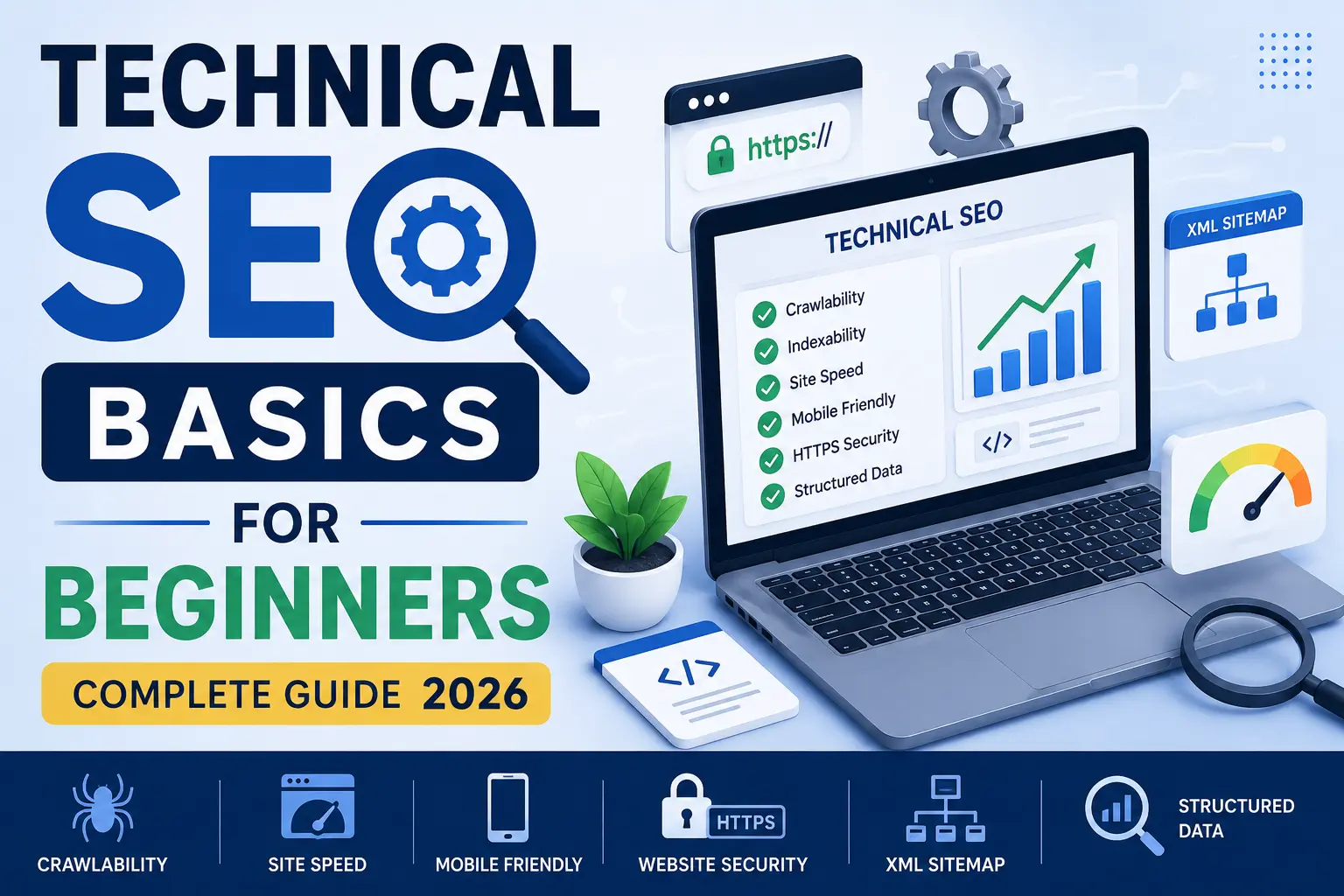
Technical SEO Basics for Beginners (Complete Guide 2026)
Introduction
Building a website is just the first step. If search engines cannot properly crawl and index your site, your content will never rank—no matter how good it is. That’s where technical SEO becomes essential.
Technical SEO focuses on optimizing the backend structure of your website so that search engines like Google can easily access, understand, and rank your pages.
In this beginner-friendly guide, you’ll learn the core fundamentals of technical SEO and how to implement them step by step.
What is Technical SEO?
Technical SEO is the process of optimizing the technical aspects of a website to improve its visibility in search engines. It ensures that your website meets modern search engine requirements.
Unlike content SEO (on-page SEO) or backlink building (off-page SEO), technical SEO deals with things like site speed, mobile usability, indexing, and site architecture.
A well-optimized technical structure helps search engines crawl your website efficiently and improves overall performance.
Website Speed Optimization
Website speed is one of the most important ranking factors. A slow-loading website leads to higher bounce rates and poor user experience.
Search engines prefer fast websites because they provide a better experience to users.
To improve your website speed:
- ⚡ Compress large images
- ⚡ Enable browser caching
- ⚡ Use lightweight themes and plugins
- ⚡ Minify CSS and JavaScript files
- ⚡ Use a CDN (Content Delivery Network)
A faster website not only improves rankings but also increases conversions and user engagement.
Mobile-Friendly Website
Most users today browse the internet on mobile devices. That’s why search engines follow mobile-first indexing, meaning they primarily use the mobile version of your site for ranking.
If your website is not mobile-friendly, you are losing a significant amount of traffic.
To optimize for mobile:
- 📱 Use responsive design
- 📱 Ensure text is readable without zooming
- 📱 Keep buttons easy to tap
- 📱 Avoid intrusive pop-ups
A mobile-optimized website improves both SEO performance and user satisfaction.
Secure Website (HTTPS)
Website security is a confirmed ranking factor. If your website is not secure, users may see warnings like “Not Secure” in their browser.
Installing an SSL certificate converts your site from HTTP to HTTPS, ensuring a secure connection.
Benefits of HTTPS:
- 🛡️ Builds user trust
- 🛡️ Protects user data
- 🛡️ Improves search rankings
A secure website is now a basic requirement for SEO success.
XML Sitemap
An XML sitemap is a file that lists all the important pages of your website. It helps search engines discover and index your content more efficiently.
This is especially useful for:
- 📍 New websites
- 📍 Large websites
- 📍 Sites with weak internal linking
You can create a sitemap using SEO plugins and submit it in Google Search Console.
Submitting a sitemap ensures that your pages are indexed faster and more accurately.
Robots.txt File
The robots.txt file tells search engine bots which pages they are allowed to crawl and which ones to ignore.
Example (Clear View):
This helps control how search engines interact with your website.
However, you must use it carefully. Blocking important pages by mistake can harm your SEO performance.
Fixing Broken Links
Broken links negatively impact both user experience and search rankings. When users land on a 404 error page, they are more likely to leave your website.
There are two types of broken links:
- 🔗 Internal broken links
- 🔗 External broken links
To fix them:
Perform regular audits
Use tools like Ahrefs or Screaming Frog
Apply 301 redirects where necessary
Maintaining clean links improves your website’s credibility and SEO health.
SEO-Friendly URL Structure
Your URL structure should be simple, clear, and keyword-focused.
Good URL:
Bad URL:
SEO-friendly URLs:
- ✔ Are short and descriptive
- ✔ Include relevant keywords
- ✔ Avoid unnecessary parameters
Clean URLs help both users and search engines understand your content better.
Structured Data (Schema Markup)
Structured data helps search engines better understand your content by providing additional context.
It can enhance your search results with rich snippets such as:
- ✨ Star ratings
- ✨ FAQs
- ✨ Product details
This improves your click-through rate (CTR) and visibility in search results.
Implementing schema markup is a powerful way to stand out in search listings.
Canonical Tags
Duplicate content can confuse search engines and dilute your rankings. Canonical tags solve this problem by telling search engines which version of a page is the original.
Example:
Using canonical tags ensures that your SEO value is not split across multiple URLs.
Crawlability and Indexing
If your website is not crawlable or indexable, it won’t appear in search results.
You can monitor your site’s indexing status using Google Search Console.
To improve crawlability and indexing:
- 🔎 Strengthen internal linking
- 🔎 Submit your sitemap
- 🔎 Fix crawl errors
- 🔎 Avoid blocking important pages
Proper indexing ensures your pages are visible in search engine results.
Technical SEO Tools
To effectively manage technical SEO, you should use the following tools:
Google Search Console
Google Analytics
Ahrefs
Screaming Frog SEO Spider
These tools help analyze your website performance, identify issues, and improve SEO.
Common Technical SEO Mistakes
Many beginners make simple mistakes that affect their website performance:
- ❌ Ignoring website speed
- ❌ Not optimizing for mobile
- ❌ Missing XML sitemap
- ❌ Leaving broken links unfixed
- ❌ Duplicate content issues
- ❌ Incorrect redirects
Avoiding these mistakes can give you a strong advantage over competitors.
Conclusion
Technical SEO is the foundation of a successful website. Without it, even the best content may fail to rank.
By focusing on:
- ✔ Website speed
- ✔ Mobile optimization
- ✔ Security
- ✔ Proper indexing
You can significantly improve your website’s visibility on search engines like Google.
Start implementing these technical SEO basics step by step, and you will see long-term growth in traffic and rankings.