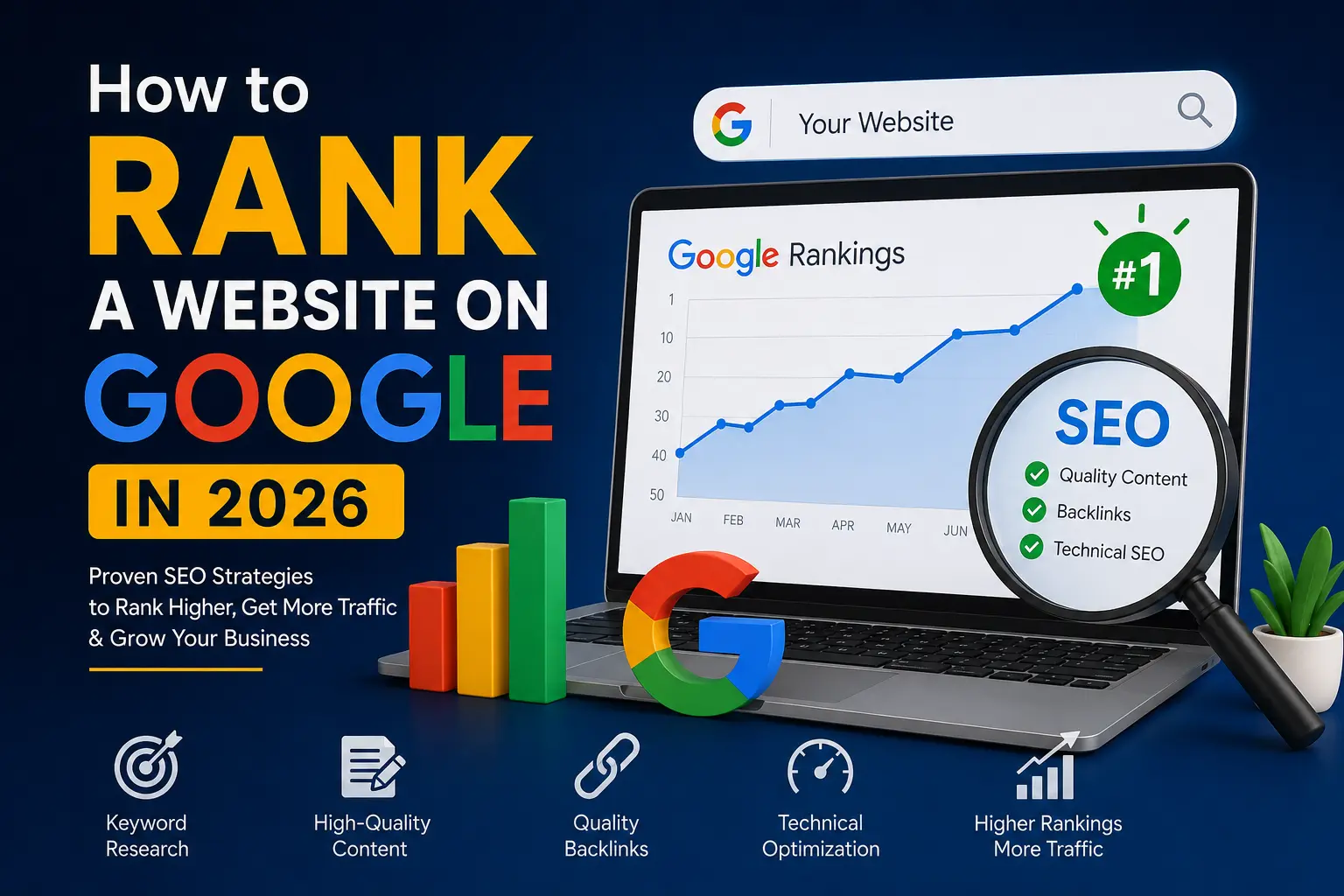
How to Rank a Website on Google in 2026: What Actually Works Today
Introduction
If you search for “How to Rank a Website on Google,” you will find thousands of articles repeating the same advice: publish content, build backlinks, optimize keywords, and improve website speed. While those recommendations are not wrong, they rarely explain why some websites grow quickly while others remain invisible for years.
The truth is that Google has changed dramatically. A few years ago, many websites could rank simply by targeting keywords and building large numbers of backlinks. Today, Google is far better at understanding content quality, user behavior, and search intent. This means website owners must think beyond traditional SEO checklists.
"Ranking a website is no longer about tricking a search engine. It is about becoming the best answer for a specific search query."
In this guide, you will learn the practical SEO principles that continue to work in 2026 and how you can apply them to improve your website’s visibility.
Why Most Websites Never Reach Page One
One of the biggest mistakes website owners make is creating content without understanding what users actually want.
For example, imagine two websites targeting the same keyword. The first website publishes a generic article filled with definitions and basic information. The second website answers common questions, provides examples, solves real problems, and makes information easy to understand.
Google will almost always prefer the second option because it creates a better experience for visitors. This is why successful SEO starts with understanding people before understanding algorithms.
Stop Thinking About Keywords First
Many beginners open a keyword tool and immediately start looking for search volume. That approach often leads to disappointment. Instead of asking “What keyword should I target?”, ask “What problem is my audience trying to solve?”.
For example, someone searching for website ranking advice may actually want:
- 🚀 More business inquiries
- 📈 More organic traffic
- 📍 Better local visibility
- 🔝 Higher Google rankings
- 🛡️ Increased website authority
By understanding the intent behind a search, you can create content that satisfies users more effectively than competitors.
Search Intent Is More Important Than Keyword Density
A common SEO misconception is that repeating a keyword multiple times improves rankings. Google has become much smarter than that.
If a user searches for “How to Rank a Website on Google,” Google expects content that explains the ranking process, not a page that repeatedly uses the same phrase.
Instead of obsessing over keyword density, focus on topic coverage. Include related concepts naturally such as:
- 🔹 Search engine optimization
- 🔹 Organic traffic growth
- 🔹 Website authority
- 🔹 Content marketing
- 🔹 Technical SEO
- 🔹 User experience
- 🔹 Search visibility
When you fully cover a topic, Google understands your page without needing excessive keyword repetition.
Create Content That Deserves to Rank
Before publishing any article, ask yourself a simple question: “Would someone bookmark this page or share it with another person?” If the answer is no, the content probably needs improvement.
The best-performing pages usually include:
✅ Real Examples
People learn faster when they see practical examples. Instead of saying “Improve page speed,” explain how reducing image sizes improved loading times and user engagement.
✅ Clear Structure
Visitors should be able to scan your page quickly. Use:
- Headings
- Subheadings
- Bullet points
- Short paragraphs
Good structure improves both readability and SEO performance.
✅ Original Insights
Google increasingly rewards originality. If your content simply repeats information available on hundreds of websites, it becomes difficult to stand out. Adding personal observations, case studies, or unique perspectives can significantly improve content quality.
Why Website Experience Matters More Than Ever
Many website owners focus entirely on content and forget about user experience. Imagine finding a helpful article but waiting ten seconds for it to load—most visitors will leave before reading a single sentence.
Google notices these signals. A positive website experience includes:
- ⚡ Fast loading pages
- 📱 Mobile responsiveness
- 🧭 Clear navigation
- 📖 Readable design
- 🔒 Secure browsing
SEO and user experience are no longer separate disciplines. They work together.
Internal Linking: The Hidden SEO Advantage
One of the most overlooked SEO opportunities is internal linking. Think of your website as a city; internal links act as roads connecting different locations. Without those roads, search engines struggle to understand relationships between pages.
For example, if you publish an article about website rankings, you can naturally connect it to:
- 🔹 SEO Services
- 🔹 Local SEO Guides
- 🔹 Google Business Profile Optimization
- 🔹 Digital Marketing Strategies
- 🔹 Website Development Resources
This creates a stronger topical structure and helps search engines understand your expertise.
Authority Is Built Through Consistency
Many people expect immediate SEO results, but search visibility rarely grows overnight. Google wants evidence that your website consistently provides value. Publishing one excellent article is helpful, but publishing dozens of useful articles over time is what truly builds authority.
Websites that grow steadily often follow a simple process:
- ✅ Publish useful content.
- ✅ Improve existing content.
- ✅ Earn relevant backlinks.
- ✅ Strengthen internal links.
- ✅ Continue serving user needs.
Consistency often beats complexity in SEO.
Think Like a Publisher, Not an Optimizer
The websites that dominate search results usually focus on helping readers rather than chasing algorithms. Instead of asking “How can I rank?”, ask “How can I create the best resource on this topic?”.
When your content genuinely helps users, ranking signals improve naturally:
- 📈 Engagement increases.
- ⏳ Visitors stay longer.
- 📄 More pages are viewed.
- 🔗 Backlinks are earned.
- ⭐ Brand trust grows.
These are the signals Google ultimately wants to reward.
Backlinks Are Still Important, But Not in the Way Most People Think
For years, SEO was heavily focused on link building. However, Google has become far more sophisticated. Today, one relevant backlink from a trusted website can be more valuable than hundreds of low-quality links from unrelated sources.
Think of backlinks as recommendations. If a respected website references your content, Google sees that as a signal of trust. The most sustainable approach is to earn links by publishing content that people genuinely find useful, insightful, or unique.
Topical Authority Is Replacing Traditional SEO Thinking
One of the biggest shifts in modern SEO is Google's focus on topical authority. Google prefers websites that demonstrate expertise within a specific subject area.
The second website in our comparison—the one focused entirely on digital marketing, SEO, Google Ads, local search optimization, and website growth—sends stronger signals of expertise because every article supports the same core topic.
If your goal is long-term organic growth, create content clusters instead of isolated articles. Every new piece of content should strengthen your website's overall authority.
Why Google Rewards Experience More Than Information
Information alone is no longer enough; millions of pages already explain basic SEO concepts. Google increasingly values content that demonstrates real experience.
Whenever possible, include:
- ✅ Personal observations
- ✅ Real examples
- ✅ Practical outcomes
- ✅ Challenges encountered
- ✅ Lessons learned
Experience creates credibility. Credibility creates trust. Trust improves rankings.
The Role of E-E-A-T in Modern SEO
Google frequently evaluates websites using E-E-A-T (Experience, Expertise, Authoritativeness, and Trustworthiness). Many owners focus on technical SEO while ignoring trust, yet trust influences nearly every ranking signal.
Simple improvements such as detailed author information, contact pages, privacy policies, and regularly updated content can strengthen trust signals.
Local SEO Can Be a Competitive Advantage
For service-based businesses, local SEO often produces faster results. Consider these high-intent search phrases:
- 📍 SEO agency near me
- 📍 Taxi service in Dehradun
- 📍 Website designer in Uttarakhand
- 📍 Digital marketing company nearby
Optimizing your Google Business Profile, collecting genuine customer reviews, and creating location-specific service pages can significantly improve local visibility. For many businesses, local rankings generate more revenue than national rankings.
Google Search Console Is an Underused Goldmine
Many website owners install Google Search Console and rarely check it again—this is a massive missed opportunity. Search Console provides direct insight into how Google views your website, revealing:
- 🔍 Which keywords generate impressions
- 🖱️ Which pages receive clicks
- 📈 Where rankings are improving
- 💡 Which opportunities are being missed
One of the most valuable SEO habits is reviewing Search Console data regularly. Sometimes a page already ranks on page two for an important keyword, and a few content improvements may be enough to move it onto page one. Without data, those opportunities remain hidden.
Why Patience Is a Competitive Advantage
One reason many websites fail is unrealistic expectations. SEO is often marketed as a quick solution, but in reality, sustainable rankings require time. Google needs evidence, which comes from:
- ✅ Consistent publishing
- ✅ User engagement
- ✅ Website growth
- ✅ Link acquisition
- ✅ Topic coverage
- ✅ Trust development
Most competitors quit too early, seeing limited results and stopping. Meanwhile, websites that continue improving month after month gradually build momentum. Patience is not simply a virtue in SEO—it is a competitive advantage.
Measuring the Right Metrics
Many people become obsessed with rankings, but while they matter, they are not the ultimate goal. The real objective is business growth. Instead of focusing only on keyword positions, pay attention to:
- ✅ Organic Traffic Quality: Are visitors actually interested in your services?
- ✅ Engagement: Do people stay on your pages and explore additional content?
- ✅ Leads and Inquiries: Are rankings generating real opportunities?
- ✅ Conversion Rate: Are visitors becoming customers?
- ✅ Brand Visibility: Are more people discovering your business through search?
The best SEO campaigns focus on outcomes rather than vanity metrics.
The Future of Ranking on Google
Search engines continue to evolve with artificial intelligence and semantic search. Despite these changes, one principle remains consistent: Google wants to deliver the best possible answer. The foundation remains the same:
- 🔹 Create content that genuinely helps people.
- 🔹 Provide a better experience than competing websites.
- 🔹 Demonstrate expertise.
- 🔹 Build trust over time.
Websites that follow these principles are far more likely to succeed regardless of future algorithm updates.
Monitoring Technical Health
Consistent rankings require maintaining your website's technical health. Google rewards websites that load quickly and are free from broken links.
When you learn how to rank a website on Google, you must ensure your site structure is search-engine friendly. Regular audits help you resolve technical issues, which is a necessary step if you want to know how to rank a website on Google effectively in 2026.
Focusing on User Engagement Signals
Modern algorithms place heavy emphasis on user engagement signals. If your content fails to engage readers, maintaining your search position becomes difficult. Therefore, use relevant internal links and clear call-to-actions within your articles.
When you provide a better reading experience, visitors stay on your site longer. These positive behavioral signals inform Google that your page delivers high-quality content, which is the most effective way to understand how to rank a website on Google for the long term.
Leveraging Analytical Insights
Data-driven decisions are vital for success in 2026. By tracking how your audience interacts with your site, you gain clear insights into how to rank a website on Google by optimizing your most popular content.
Don't guess what your readers want; look at your data to identify content gaps and refine your strategy. Mastering these insights is essential for anyone serious about learning how to rank a website on Google and maintaining consistent growth.
Prioritizing Quality Over Quantity
Google’s latest updates heavily favor helpful, human-centered content. Avoid the temptation to churn out mass-produced pages, as search engines now prioritize depth and relevance.
The most successful approach to how to rank a website on Google is to ensure every single page provides unique value to the reader. By focusing on quality, you build the trust and authority needed to understand how to rank a website on Google effectively for years to come.
Why Keyword Placement Matters for SEO
Understanding how to rank a website on Google involves more than just writing quality text. You must ensure your primary topic is clear to search engines from the very beginning.
By strategically placing your main keyword in your headings and the first paragraph, you help Google identify what your page is about. When you learn how to rank a website on Google correctly, you avoid keyword stuffing while still signaling your page's relevance to search crawlers.
Mastering the Ranking Process
Many people struggle because they ignore technical signals. If you want to master how to rank a website on Google, you must balance your content with technical health.
Ensure your URLs, meta tags, and image alt texts support your main topic. Focusing on these small details is often the difference between page two and page one. Consistently applying these steps will show you exactly how to rank a website on Google effectively.
Aligning Strategy with Search Results
To succeed in 2026, you must align your content with user expectations. If you are researching how to rank a website on Google, observe what currently appears in the top three results.
Are they using videos, tables, or step-by-step guides? Mimicking the format of top-performing pages while adding your own unique value is a proven method for those asking how to rank a website on Google. This alignment ensures that Google sees your content as the most helpful answer for the user.
The Long-Term SEO Roadmap
Building a lasting presence takes more than a one-time effort. When you map out how to rank a website on Google, plan for continuous updates and regular content refreshes. SEO is not a static task; it requires monitoring your performance and adjusting based on what your audience actually needs.
By staying committed to the process, you will eventually master how to rank a website on Google and enjoy sustained growth, ensuring your business stays ahead of the competition throughout the year.
Avoiding Common SEO Pitfalls
Many beginners accidentally sabotage their rankings by using outdated black-hat techniques. If you are serious about learning how to rank a website on Google, avoid practices like keyword stuffing or buying low-quality backlinks, as these can trigger penalties.
Stick to ethical strategies that focus on the user, as this remains the safest path to understand how to rank a website on Google in a competitive digital landscape.
Staying Adaptable in 2026
The digital marketing environment changes rapidly. To succeed, you must stay flexible and monitor industry updates regularly.
By remaining adaptable and keeping your core strategy focused on user value, you will find it much easier to determine how to rank a website on Google despite constant algorithmic shifts. Continuous learning is the ultimate key for anyone wondering how to rank a website on Google successfully throughout the year.
The Importance of Content Refreshing
Content can become outdated, which negatively impacts your visibility. Periodically updating your articles with new information is a proven tactic for anyone studying how to rank a website on Google.
By keeping your information current and accurate, you signal to search engines that your site is active and relevant, which is a major factor in how to rank a website on Google today.
Building a Sustainable SEO Strategy
Success is the result of long-term planning rather than short-term gains. When you develop a strategy to learn how to rank a website on Google, focus on building a brand that users trust.
By consistently providing value and solving user problems, you solidify your authority, which ultimately makes it easier to understand how to rank a website on Google and maintain your position at the top of the results.
Final Thoughts
If you want to understand how to rank a website on Google, stop looking for shortcuts. There is no secret formula, hidden trick, or magical SEO tool that guarantees rankings.
Successful websites earn visibility by becoming valuable resources:
- ✅ They understand their audience.
- ✅ They answer real questions.
- ✅ They improve continuously.
- ✅ They focus on trust rather than manipulation.
The websites that win in search are rarely the ones trying to outsmart Google. They are the ones working hardest to serve their visitors. When you shift your focus from ranking first to helping users first, rankings often follow naturally.
That is what actually works in modern SEO—and it is likely to remain true for years to come.