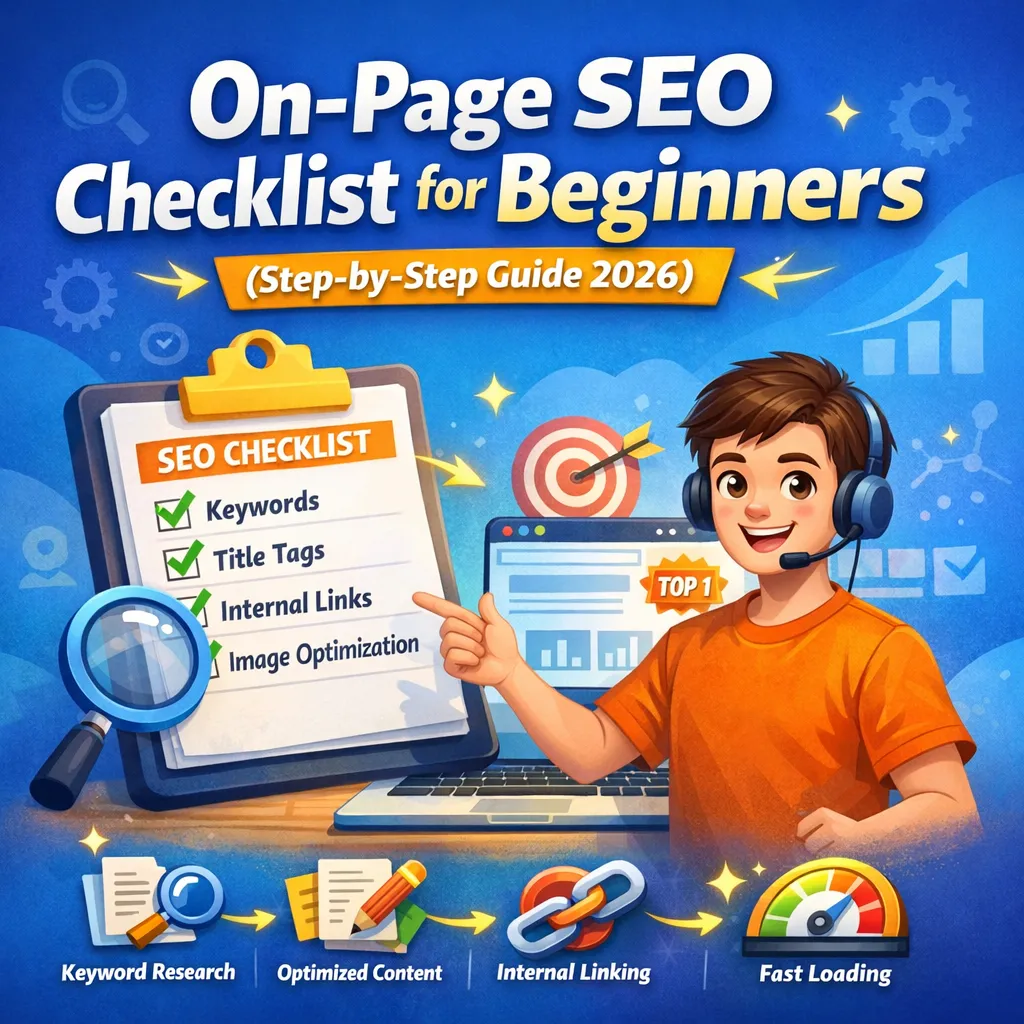
On Page SEO Checklist for Beginners (Step-by-Step Guide 2026)
Introduction
If your website is not ranking on Google, the problem is often not backlinks or ads — it’s your on-page SEO. Many beginners ignore this part, but the truth is simple: without proper page optimization, your content cannot perform well in search results.
On page SEO is the process of optimizing your website pages so that search engines understand your content clearly and users get the best experience. From content structure to keyword placement, everything matters.
If you are new to SEO, you should first understand the basics in our What is SEO? Complete Beginner Guide (2026), and then apply this checklist step by step.
In this guide, you’ll learn a complete on-page SEO checklist that is easy to implement, beginner-friendly, and designed for real ranking results.
Understanding On Page SEO Checklist for Beginners
On Page SEO checklist for beginners is not just a technical process, but a practical strategy that helps your website grow step by step. When you follow a proper On Page SEO checklist for beginners, you improve not only your rankings but also the overall user experience.
Many website owners ignore these basics, but a well-structured On Page SEO checklist for beginners can make a huge difference in traffic and visibility.
What is On Page SEO?
On page SEO refers to all the optimization techniques you apply directly on your website pages to improve rankings.
It includes:
- ✦ Content optimization
- ✦ Title and meta tags
- ✦ Internal linking
- ✦ URL structure
- ✦ Image optimization
- ✦ User experience improvements
Unlike off-page SEO, which depends on external factors, on-site optimization is fully under your control.
Why You Need an On Page SEO Checklist
Understanding the on page SEO checklist for beginners helps you focus on the right elements instead of guessing what works. A complete on page SEO checklist for beginners ensures that your content, structure, and technical setup are aligned with search engine requirements.
This approach makes your website more visible and easy to rank.
Why On Page SEO Matters in 2026
Search engines have become smarter. Google now focuses more on:
User intent
Content quality
Page experience
This means your page must not only include keywords but also deliver real value.
If you are running a business website or planning to grow online, you should also explore a proper Digital Marketing Strategy for Beginners, because SEO works best when combined with other marketing methods.
Complete On Page SEO Checklist
1. Start with Proper Keyword Research
Everything in SEO starts with the right keyword. Instead of targeting broad keywords, focus on:
- ➤ Long-tail keywords
- ➤ Low competition phrases
- ➤ User intent-based searches
For example, instead of targeting “SEO”, use:
- on page SEO checklist
- website optimization guide
- beginner SEO tips
Also, use keyword variations naturally throughout your content to avoid repetition.
2. Write a Powerful SEO Title
Your title directly affects both ranking and clicks. A good title should:
- ➤ Include your main keyword
- ➤ Be under 60 characters
- ➤ Create curiosity
Example:
On-Page SEO Checklist for Beginners (Complete Guide 2026)
Adding numbers, power words, and the year improves visibility.
3. Optimize Meta Description for Clicks
Your meta description doesn’t directly impact ranking but plays a big role in CTR. Write a short, engaging summary that:
- ➤ Includes keyword naturally
- ➤ Encourages users to click
- ➤ Clearly explains value
Keep it simple and user-focused.
4. Use Clean and SEO-Friendly URLs
Your page URL should be simple and readable.
- ✖ Long URLs
- ✖ Random numbers
- ✖ Unnecessary words
Short URLs improve both SEO and user experience.
5. Structure Content with Proper Headings
A well-structured article is easier to read and rank. Use:
- ➤ H1 for main title
- ➤ H2 for sections
- ➤ H3 for sub-sections
This helps search engines understand your content better and improves readability.
6. Focus on High-Quality Content
Content is the heart of SEO. Your content should:
- ➤ Solve real problems
- ➤ Be easy to understand
- ➤ Be original and unique
- ➤ Provide complete information
If you are writing for business growth, combining SEO with insights from Importance of Digital Marketing for Small Businesses can help you create more valuable content.
Avoid writing just for search engines — always write for humans first.
9. Optimize Images Properly
Images improve engagement but must be optimized. Best practices include compression, descriptive names, and adding ALT text.
This helps search engines understand your images without breaking your site's premium look.
10. Improve Website Speed
Page speed is a ranking factor. Slow websites lead to:
- ✖ Higher bounce rate
- ✖ Lower rankings
Improve speed by:
- ➤ Using optimized images
- ➤ Enabling caching
- ➤ Choosing good hosting
A fast website always performs better in SEO.
11. Make Your Website Mobile-Friendly
Most users visit websites from mobile devices. Ensure:
- ➤ Responsive design
- ➤ Easy navigation
- ➤ Fast mobile loading
Google uses mobile-first indexing, so your mobile experience must be perfect.
12. Use External Links for Trust
Linking to trusted websites increases credibility. It shows that your content is well-researched and reliable.
But:
- ➤ Only link to relevant sources
- ➤ Avoid low-quality links
13. Improve User Experience (UX)
User experience directly affects rankings. Focus on:
- ➤ Clean layout
- ➤ Easy navigation
- ➤ Readable fonts
- ➤ Proper spacing
If users stay longer on your site, Google sees your content as valuable.
14. Use Call-To-Action (CTA)
Every page should guide users. Examples:
- Contact us
- Book a service
- Read more articles
CTA helps convert visitors into customers.
15. Keep Content Updated
SEO is not a one-time task. Regularly update:
- ➤ Content
- ➤ Keywords
- ➤ Links
Fresh content performs better in search results.
Common Mistakes Beginners Make
Many beginners make technical and content-related errors that stop their website from ranking. Avoid these errors:
Overusing keywords
Ignoring content quality
Not using internal links
Slow website speed
Poor mobile experience
Fixing these can instantly improve your performance.
Final Thoughts
On-page SEO is the foundation of your website’s success. If your pages are not properly optimized, no amount of backlinks or ads will give long-term results.
Start implementing this checklist step by step. Focus on creating useful content, improving structure, and delivering a better user experience.
Once your on-page SEO is strong, your website will automatically start gaining better rankings and more traffic.