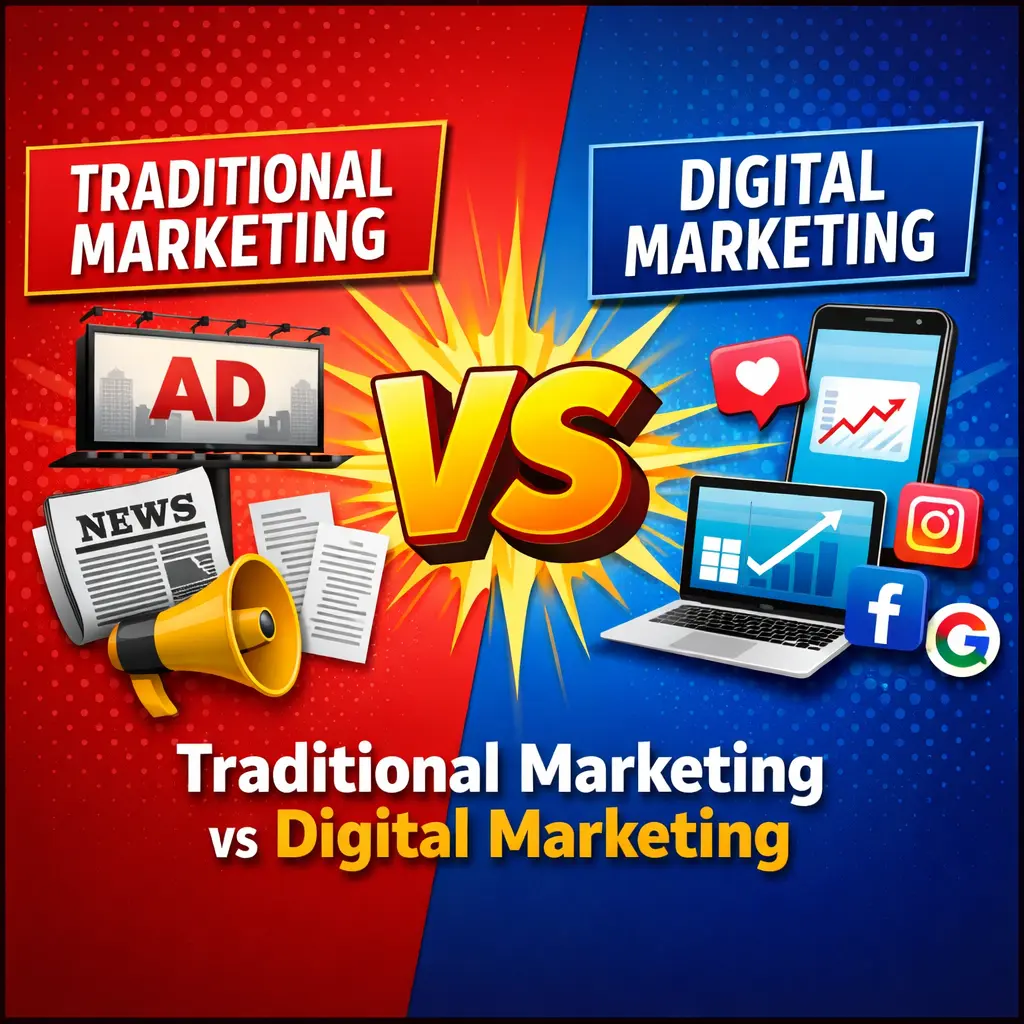
Traditional Marketing vs Digital Marketing:
Best Comparison Guide 2026
In 2026, every business wants growth, more customers, and higher sales. But one common confusion that many business owners face is choosing between offline advertising and online promotion. Some people still trust newspaper ads and hoardings, while others believe internet marketing is the future. The truth is, both methods work, but their impact depends on your business type, target audience, and budget.
This blog will explain Traditional Marketing vs Digital Marketing in a complete and beginner-friendly way. You will learn the key differences, advantages, disadvantages, cost comparison, and which method is best for your business in 2026.
👉 Expert Solutions: Explore our Digital Marketing Service in Dehradun
Traditional Marketing vs Digital Marketing
What is Traditional Marketing?
Traditional marketing refers to offline marketing methods used for business promotion before the internet became popular. It mainly focuses on reaching customers through physical and mass media platforms.
Traditional marketing includes:
- Newspaper advertisements
- TV commercials
- Radio ads
- Pamphlets and flyers
- Billboards and hoardings
- Posters and banners
- Direct sales and cold calling
Traditional marketing is widely used for brand awareness and works well for local advertising.
What is Digital Marketing?
Digital marketing means promoting products or services using online platforms and digital channels. It helps businesses reach targeted customers through the internet, smartphones, and social media.
Digital marketing includes:
- Search Engine Optimization (SEO)
- Google Ads & PPC Campaigns
- Social Media Marketing
- Email Marketing & Automation
- Content Marketing & Blogging
- WhatsApp & SMS Marketing
- Influencer & Affiliate Marketing
Digital marketing is cost-effective, measurable, and allows real-time interaction with customers in 2026.
🏆 Traditional Marketing vs Digital Marketing: Key Differences
The main difference is simple: Traditional marketing works through offline channels, while digital marketing works through online platforms. Let’s compare important business factors step-by-step.
1. Cost Comparison
Usually expensive and requires high upfront investment.
More affordable and flexible. Campaigns can start with a small budget.
2. Audience Targeting
Targets a broad audience with limited control.
Advanced targeting by location, age, interests, and keywords.
3. Reach and Coverage
Limited to specific geographic areas.
Can reach customers globally through online platforms.
4. Tracking and Measurement
Difficult to measure exact performance.
Full tracking of clicks, leads, and ROI using analytics tools.
5. Speed of Results
Takes time and repeated exposure.
Paid ads can generate leads within hours.
6. Customer Engagement
Mostly one-way communication.
Enables direct interaction through social media and messaging.
7. Flexibility and Updates
Hard to modify once printed or published.
Ads and content can be updated instantly.
8. Branding and Trust Building
Strong credibility through TV and newspapers.
Builds trust via reviews, content, and social proof.
Advantages and Disadvantages of Traditional Marketing
Advantages of Traditional Marketing
- Works well for local awareness
- Best for rural and offline audience
- Helps in mass marketing campaigns
- Builds credibility through newspapers and TV
- Good for local shops and events
Disadvantages of Traditional Marketing
- Expensive advertising cost
- Difficult to track ROI
- Limited targeting options
- Not flexible for updates
- Results take time
Advantages and Disadvantages of Digital Marketing
Advantages of Digital Marketing
- Low cost and budget flexibility
- Advanced targeting
- Instant lead generation
- Easy tracking and reporting
- Better customer engagement
- 24/7 promotion
- Works for local and national businesses
These benefits make Traditional Marketing vs Digital Marketing comparison strongly in favor of online marketing.
Disadvantages of Digital Marketing
- High competition in ads
- SEO takes time to rank
- Needs technical skills
- Requires regular content and optimization
- Wrong strategy can waste money
But with expert planning, online promotion becomes highly profitable.
Traditional Marketing vs. Digital Growth
| FEATURE | TRADITIONAL MARKETING | DIGITAL MARKETING (ACS IT HUB) |
|---|---|---|
| Reach | Local / Limited Audience | Global Reach & Specific Targeting |
| Cost | High (Print, TV, Billboards) | Budget-Friendly & Scalable |
| Tracking | Difficult to Measure ROI | Real-time Analytics & Data |
| Engagement | One-way Communication | Two-way Interactive Engagement |
| Speed | Long-term Planning Required | Instant Execution & Results |
| Conversion | Manual & Slow Process | Automated Funnels & High ROI |
🏆 Quick Conclusion
For Leads & Sales: Digital Marketing is the clear winner for ROI and tracking.
For Mass Offline Branding: Traditional Marketing still plays a role in physical visibility.
Best Strategy: A Hybrid Approach yields the strongest results for scaling a modern brand.
Which is Best in 2026?
The answer depends on your business goals. If you want fast leads, high ROI, and measurable results, digital marketing is the best choice.
However, if your target customers are local and offline, traditional marketing can still work.
The best approach is to combine both methods. Many successful businesses use both strategies for maximum growth.
💡 PRO TIP: That’s why understanding Traditional Marketing vs Digital Marketing is important before spending your marketing budget.
Best Strategy: Combine Traditional and Digital Marketing
A smart marketing plan in 2026 should include a mix of online and offline methods to achieve both quick results and long-term growth.
- SEO for free long-term traffic
- Google Ads for instant leads
- Social media for engagement
- Pamphlets for local awareness
- Hoardings for brand visibility
This combination gives faster results and long-term business growth.
👉 Grow Socially: Explore our Social Media Marketing Service
Expert Insights: Marketing in 2026
Traditional marketing uses offline channels like TV, newspapers, and hoardings, while digital marketing uses online platforms such as Google, social media, and websites.
For most businesses, digital marketing is more effective because it offers precise targeting, real-time tracking, and better ROI. Traditional marketing still helps with mass brand awareness.
Yes. Digital marketing can start with a small daily budget, whereas traditional marketing usually requires a large upfront investment.
Digital marketing is better for small businesses because it is budget-friendly, measurable, and scalable.
Yes. Traditional marketing still works well for rural audiences, older demographics, and large-scale brand awareness campaigns.
- Google Ads: Same day
- Social Media Ads: 1–3 days
- SEO: Typically 3–6 months
Yes. A hybrid strategy often gives the best results by combining online lead generation with offline brand visibility.
Digital marketing is much easier to track using analytics tools that show clicks, leads, and conversions in real time.
Absolutely. Local SEO, Google Ads, and WhatsApp marketing are highly effective for local service businesses to get immediate bookings.
It is declining but unlikely to disappear completely. However, digital marketing will continue to dominate future marketing strategies.
Conclusion
In the modern era, online promotion is dominating because it is affordable, trackable, and target-based. But offline marketing still has value for local awareness and brand credibility.
When comparing Traditional Marketing vs Digital Marketing, it is clear that digital methods provide better targeting, faster results, and measurable ROI. However, traditional marketing still supports branding in offline markets.
💡 PRO TIP: If you want business growth in 2026, the best strategy is to use digital marketing for leads and sales, and traditional marketing for local trust building.